

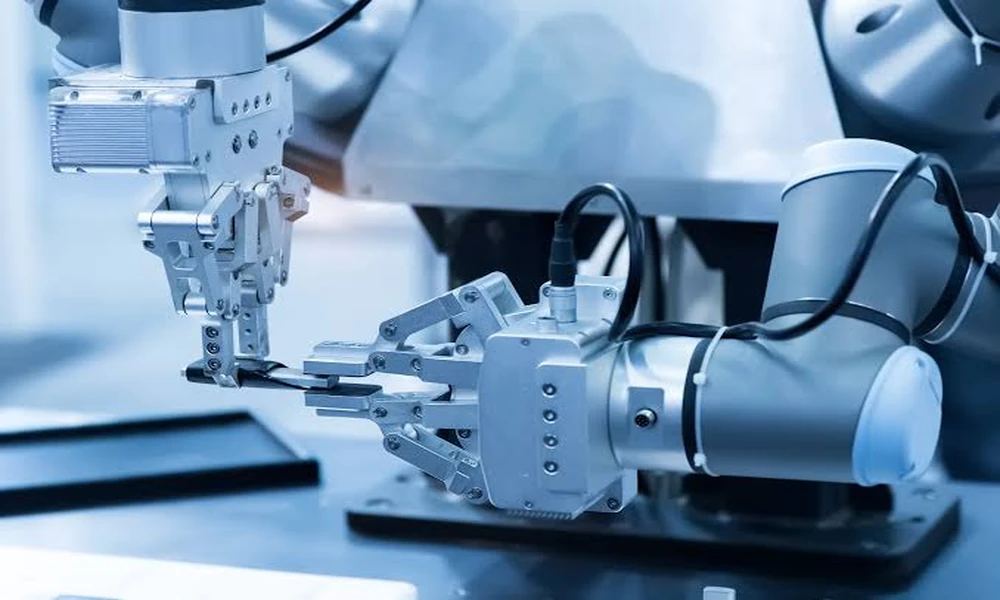
Robot specifications attract a great deal of attention during an automation project. Engineers compare payload, reach, speed and repeatability, yet the robot arm itself often never touches the product. The physical interaction is performed by the end effector, which means that tool selection can have just as much influence on the success of the application as the robot model.
Choosing the right tool begins with the process. The objective is not to find the most advanced gripper available, but to identify the simplest reliable way to handle the actual workpiece under real production conditions.
Start with the object being handled
A useful robot tooling selection process should begin with the workpiece. Its weight matters, but so do its dimensions, material, surface condition, stiffness and orientation. A rigid machined component and a flexible package may weigh the same while requiring completely different gripping principles.
Several common technologies are available. Two-finger grippers are suitable for many predictable shapes, vacuum systems can be effective on boxes and flat surfaces, and magnetic tools can simplify handling of suitable steel components. OnRobot’s present portfolio includes examples of each of these approaches alongside force/torque sensors and process tools.
No technology is universally superior. Each works well when its operating principle matches the product.
Grip force alone does not guarantee reliability
A gripper may be capable of producing substantial force and still fail to hold a component consistently. Contact geometry often matters more than the headline force figure because the fingertips determine how the load is transferred to the object.
Custom fingers can improve repeatability by matching the shape of a specific component. The disadvantage is reduced flexibility when another product needs to be handled. Adjustable or interchangeable fingers offer a compromise, particularly in high-mix production where one cell may need to process several related parts.
Engineers should also consider how the system detects a successful pickup. If a component is missing or incorrectly positioned, the automation should ideally identify the problem before moving to the next operation.
Tool weight affects robot capacity
Payload calculations must include everything attached to the robot wrist. The gripper, adapters, sensors and cables all consume part of the robot’s available capacity before the workpiece is picked up. Long fingers or extensions can also move the centre of gravity away from the wrist and change the dynamic load.
This becomes especially important with smaller robots. A heavier tool may offer additional gripping capability but leave too little payload for the actual product. The better solution can sometimes be a lighter end effector rather than a larger robot, provided the process requirements are still met.
Reach should be checked in the same way. Tool length changes where the robot can position the gripping point and can create clearance problems inside machines or fixtures.
Flexibility has to be balanced against complexity
A manufacturer handling several products may be tempted to make the cell as flexible as possible. Tool changers, multiple grippers and additional sensors can certainly increase capability, but each component adds cost, weight and potential maintenance.
Tool changing makes sense when the same robot genuinely performs different operations and the utilisation benefit justifies the additional hardware. In other applications, one carefully selected configurable gripper may be simpler and more reliable.
There is also a difference between theoretical and useful flexibility. A cell capable of handling fifty products is not necessarily better than one optimised for the five products that account for most production.
Think about maintenance before installation
End effectors are exposed directly to the production environment. Fingers wear, vacuum cups deteriorate, abrasives need replacement and moving parts can become contaminated. Maintenance should therefore be included in the initial design rather than addressed only after failures appear.
Accessibility matters as well. A small wear component that takes two minutes to replace is very different from one that requires dismantling the entire tool assembly.
The best end effector is ultimately the one that makes the process reliable, maintainable and economically sensible. Robot tooling should therefore be selected at the same time as the robot, not treated as an accessory added after the main automation decisions have already been made.
