

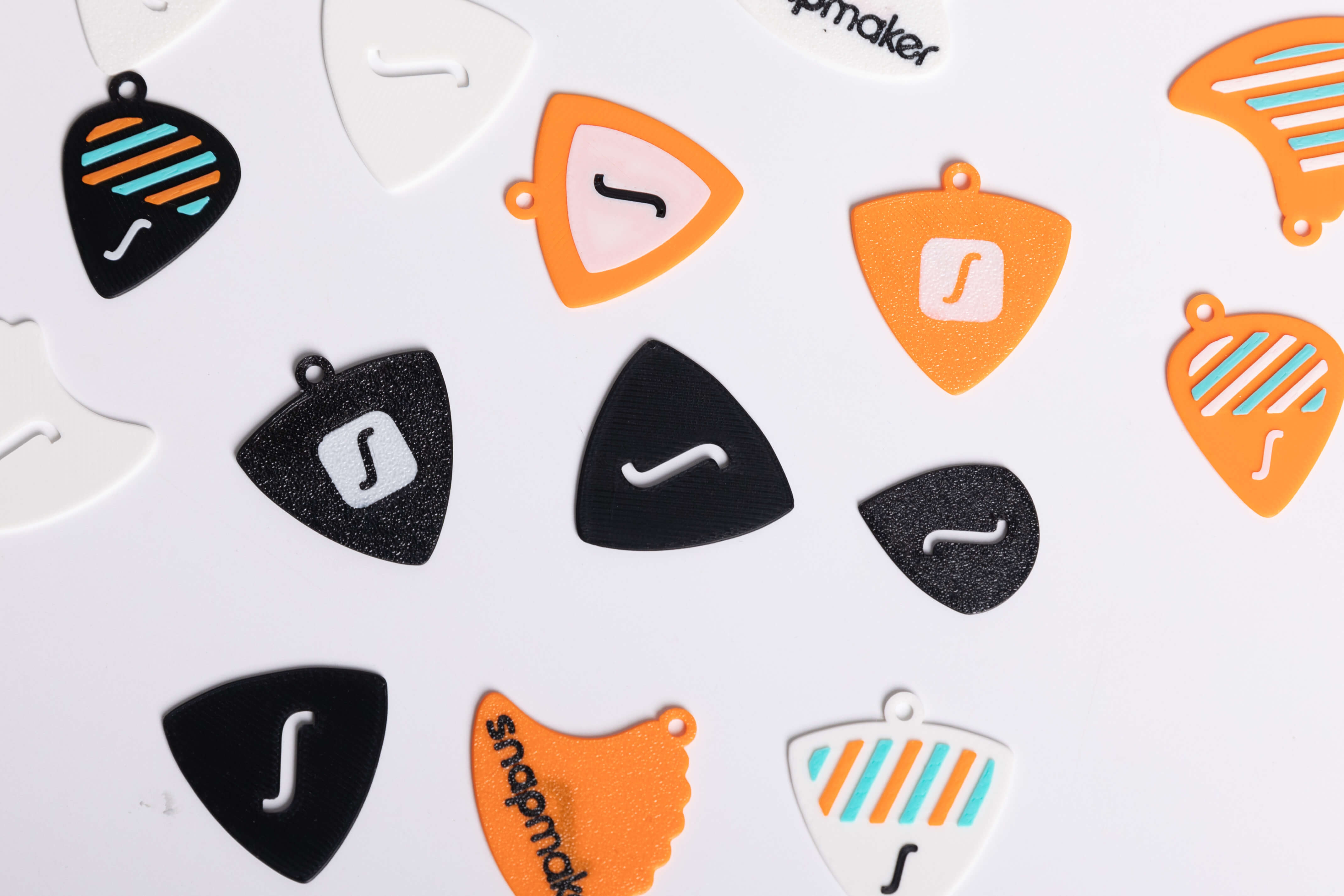
You did it. You successfully navigated the setup of your 3D printer, and that first spool of PLA filament—whether it was a sample or a full roll—is now a collection of Benchys, figurines, and useful household gadgets. You’ve mastered the basics.
But now, as you shop for your next roll, you’re hit with an alphabet soup of options: PETG, ABS, TPU, ASA, PC… What’s the difference? And which one is the right “next step” for you?
While that first spool of PLA is fantastic for learning, it has its limits. It’s relatively brittle and has a low melting point (don’t leave your PLA prints in a hot car).
Graduating to a new material is the most exciting part of 3D printing. It’s how you transform your machine from a hobbyist’s toy into a powerful manufacturing tool. Let’s break down the three most common “next-step” filaments, what they’re good for, and how to print with them.
The “Next-Step” Materials: PETG, TPU, and ABS
We’ll skip the highly-engineered, industrial plastics and focus on the three materials that every maker should get to know.
1. PETG: The Best All-Rounder
If you’re only going to try one new material, make it PETG. You’re already familiar with PET (it’s the plastic used in water bottles); the “G” in PETG stands for “glycol-modified,” which makes it stronger, more durable, and easier to 3D print.
It’s often considered the perfect hybrid, borrowing the best properties from both PLA and ABS.
- Why You’ll Love It (Pros):
- Excellent Strength: PETG is significantly stronger and more durable than PLA. It has a bit of “give,” making it far less brittle and more impact-resistant.
- Heat Resistance: It has a higher temperature resistance than PLA, so you can leave it in a hot car.
- Easy to Print: It prints at temperatures only slightly hotter than PLA, doesn’t require an enclosure, and has minimal warping.
- Often Watertight: With the right settings, PETG is a fantastic choice for printing things that need to hold liquid, like vases or planters.
- What’s the Catch? (Printing Tips):
- It’s “Stringy”: PETG is notorious for “stringing” or “oozing”—leaving fine, wispy hairs of plastic on your print. You can fix this by drying your filament and fine-tuning your retraction settings in your slicer.
- Adhesion is Too Good: It can stick so well to build surfaces like glass or PEI that it can rip off chunks. A simple layer of glue stick or painter’s tape acts as a “release agent” to prevent this.
- Best For: Functional parts, mechanical brackets, snap-fit enclosures, protective cases, and any print that needs to be tougher or more heat-resistant than PLA.
2. TPU: The Flexible One
TPU (Thermoplastic Polyurethane) is a flexible, rubber-like filament. If you’ve ever wanted to print something soft, squishy, or bouncy, this is the material you need. It opens up an entirely new category of 3D printing.
- Why You’ll Love It (Pros):
- It’s Flexible! This is its superpower. You can print items with varying “hardness” (called “shore hardness”).
- Extreme Durability: TPU is incredibly tough and resistant to abrasion and impact. It’s very difficult to break.
- Vibration Damping: It’s perfect for creating feet for printers or other appliances to reduce noise and vibration.
- What’s the Catch? (Printing Tips):
- Print S-L-O-W-L-Y: You cannot print TPU fast. The flexible filament will buckle or “clog” the extruder. You must slow your print speed way down (e.g., to 20-30 mm/s).
- Direct Drive is Best: This material is challenging for “Bowden” extruders (where the motor is on the printer’s frame). It’s much, much easier to print on a 3D printer with a “Direct Drive” extruder, where the motor is mounted directly on the print head.
- It Must Be Dry: TPU is extremely hygroscopic (it loves to absorb water from the air). Wet TPU will bubble, sizzle, and create terrible, weak prints. It must be dried before use and stored in an airtight container.
- Best For: Phone cases, flexible hinges, RC car tires, watch bands, vibration-dampening feet, and custom gaskets.
3. ABS: The Original Workhorse
ABS (Acrylonitrile Butadiene Styrene) is the original, industrial-grade 3D printing plastic. It’s the same tough plastic that LEGO bricks and car dashboards are made from. It’s more challenging to print, but it rewards you with superior properties.
- Why You’ll Love It (Pros):
- High Heat Resistance: This is its main advantage. It can withstand high-temperature environments (up to 100°C) where PLA and PETG would soften and deform.
- Very Strong & Durable: ABS parts are tough and can take a beating.
- Post-Processable: ABS can be “vapor-smoothed” using acetone, a process that melts the outer layers of the print to create a perfectly smooth, glossy, injection-molded look.
- What’s the Catch? (Printing Tips):
- It Requires an Enclosure: This is not optional. ABS shrinks significantly as it cools, which causes dramatic warping. To prevent this, you must use an enclosed printer to keep the ambient temperature high and stable.
- Heated Bed is a Must: You need a high-temperature heated bed (around 100°C-110°C) to get it to stick.
- It Produces Fumes: ABS releases strong-smelling and potentially harmful fumes (VOCs) when printed. You must print it in a well-ventilated area, and an enclosure helps contain this.
- Best For: Car parts (like a dashboard phone mount), parts for your 3D printer (which get hot), enclosures for electronics, or any functional part that needs maximum heat resistance.
How to Choose Your Second Spool
Ready to make a choice? Here’s a simple breakdown:
- Go with PETG if: You want to print stronger, tougher, and more heat-resistant functional parts without a lot of new printing headaches.
- Go with TPU if: You have a specific need for flexible, rubbery, or impact-proof parts and have the patience to print very slowly.
- Go with ABS if: You have an enclosed 3D printer and need parts that can withstand serious heat and mechanical stress.
Moving beyond PLA is a key step in your maker journey. By understanding your options, you can stop just downloading models and start designing real-world solutions. When you’re ready to explore, check out the different types of 3D printer filament available and start your next great project.
